
Quote source
“Be killing sin or it will be killing you”
The line is John Owen's, from Of the Mortification of Sin in Believers (1656), chapter 2. In the standard collected edition it falls on page 9 of volume 6 of The Works of John Owen, edited by William H. Goold. Owen is expounding Colossians 3:5 at that point, inside a treatise built on Romans 8:13.
“be killing sin or it will be killing you”
John Owen, Of the Mortification of Sin in Believers, chapter 2. The Works of John Owen, edited by William H. Goold, volume 6 (Temptation and Sin), page 9.
The full citation
| Author | John Owen (1616 to 1683) |
|---|---|
| Work | Of the Mortification of Sin in Believers (first published 1656) |
| Chapter | Chapter 2 |
| Scripture at that point | Colossians 3:5 |
| Scripture of the whole treatise | Romans 8:13 |
| Collected works | The Works of John Owen, edited by William H. Goold, volume 6 (Temptation and Sin) |
| Page | page 9 |
Cited in a footnote: John Owen, Of the Mortification of Sin in Believers, in The Works of John Owen, ed. William H. Goold (Edinburgh: Banner of Truth), 6:9.
The quote in context
Owen's text is public domain, so here is the whole paragraph the sentence sits in. The famous clause is the last in a run of five imperatives, and the sentences on either side of it change how it reads.
So the apostle, Col. iii. 5, “Mortify therefore your members which are upon the earth.” Whom speaks he to? Such as were “risen with Christ,” verse 1; such as were “dead” with him, verse 3; such as whose life Christ was, and who should “appear with him in glory,” verse 4. Do you mortify; do you make it your daily work; be always at it whilst you live; cease not a day from this work; be killing sin or it will be killing you. Your being dead with Christ virtually, your being quickened with him, will not excuse you from this work. And our Saviour tells us how his Father deals with every branch in him that beareth fruit, every true and living branch. “He purgeth it, that it may bring forth more fruit,” John xv. 2. He prunes it, and that not for a day or two, but whilst it is a branch in this world. And the apostle tells you what was his practice, 1 Cor. ix. 27, “I keep under my body, and bring it into subjection.” “I do it,” saith he, “daily; it is the work of my life: I omit it not; this is my business.” And if this were the work and business of Paul, who was so incomparably exalted in grace, revelations, enjoyments, privileges, consolations, above the ordinary measure of believers, where may we possibly bottom an exemption from this work and duty whilst we are in this world?
Of the Mortification of Sin in Believers, chapter 2. Read the chapter free at Christian Classics Ethereal Library (CCEL), chapter 2.
What Owen actually meant
Owen is not issuing a general warning to anyone who happens to read it. He is proving one specific proposition, which he states in italics at the head of the chapter: “That the choicest believers, who are assuredly freed from the condemning power of sin, ought yet to make it their business all their days to mortify the indwelling power of sin.” The people addressed are Christians whose standing before God is already secure.
That is why he presses the question “Whom speaks he to?” before the famous line. Paul writes Colossians 3:5 to people already risen with Christ, already dead with him, whose life Christ is. Owen's point is that being united to Christ does not retire a believer from this work. In his own words immediately after: “Your being dead with Christ virtually, your being quickened with him, will not excuse you from this work.”
Mortification here means the daily putting to death of indwelling sin, the corruption that remains in a believer after conversion. It is not the removal of sin in this life, which Owen denies outright in the same chapter, and it is not penance or self-punishment. It is a lifelong campaign against a living enemy, which is the force of the two participles: sin is never dormant, so the believer is never off duty.
The power for it is not the believer's own. The whole treatise is built on Romans 8:13, “If ye through the Spirit do mortify the deeds of the body ye shall live,” and Owen spends much of the book attacking attempts to kill sin by willpower, resolution, or religious duty. Quoted as a bare slogan the line sounds like grim self-effort. In context it is an argument about sanctification worked by the Holy Spirit in people who are already justified.
Is that the exact wording?
The sentence circulates in four forms. Only the first is what Owen wrote.
Exact
“be killing sin or it will be killing you”
This is the wording in the standard Goold text, with no comma and a lowercase opening, because it is the last clause in a run of imperatives: “do you make it your daily work; be always at it whilst you live; cease not a day from this work; be killing sin or it will be killing you.”
Faithful, lightly repunctuated
“Be killing sin, or it will be killing you.”
The same sentence lifted out and given a capital and a comma so it can stand alone. The sense is unchanged, and this is the form most people search for. It is fair to quote, though the clause is not a freestanding sentence in Owen.
Modernised edition
“You need to be killing sin, or it will be killing you.”
How the widely circulated modernised abridgement of the treatise renders the line, adding “You need to” where Owen has a bare imperative. Accurate in sense, but not Owen's words.
Common misquotation
“Be killing sin, or sin will be killing you.”
Very widely repeated. Ligonier Ministries runs it as an article title, and Grace to You quotes it this way in the body of an article. Owen wrote “it will be killing you,” not “sin will be killing you.” The meaning survives, so this is a slip rather than a distortion, but if a citation matters, use “it.”
How this citation was checked
- The quote appears in chapter 2, and the exact wording carries no comma.
Of the Mortification of Sin in Believers, chapter 2, Christian Classics Ethereal Library - The sentence falls on page 9: CCEL's text carries the printed page break for page 10 three sentences later, at “every branch in him that beareth fruit.”
CCEL transcription of the Goold text, with print page breaks marked - The treatise sits in volume 6 of the Goold Works, and the line is cited there as 6:9.
Banner of Truth, the publisher of the Goold edition, citing the quote as (6:9) - The treatise as a whole is built on Romans 8:13, which Owen lays out in chapter 1.
Of the Mortification of Sin in Believers, chapter 1, CCEL - A modernised edition renders the line “You need to be killing sin, or it will be killing you.”
Monergism, modernised text of The Mortification of Sin - The “sin will be killing you” form circulates widely: it is the title of a Ligonier Ministries article, and Grace to You quotes it that way in an article body.
Ligonier Ministries, “Be Killing Sin, or Sin Will Be Killing You”
Not confirmed
- The page number in the current Banner of Truth Puritan Paperback edition. Modern printings are lightly abridged and repaginated, so the page will not match the Goold text, and no page for this sentence in that edition has been confirmed here. Cite the chapter for that edition rather than a page.
Where to read it
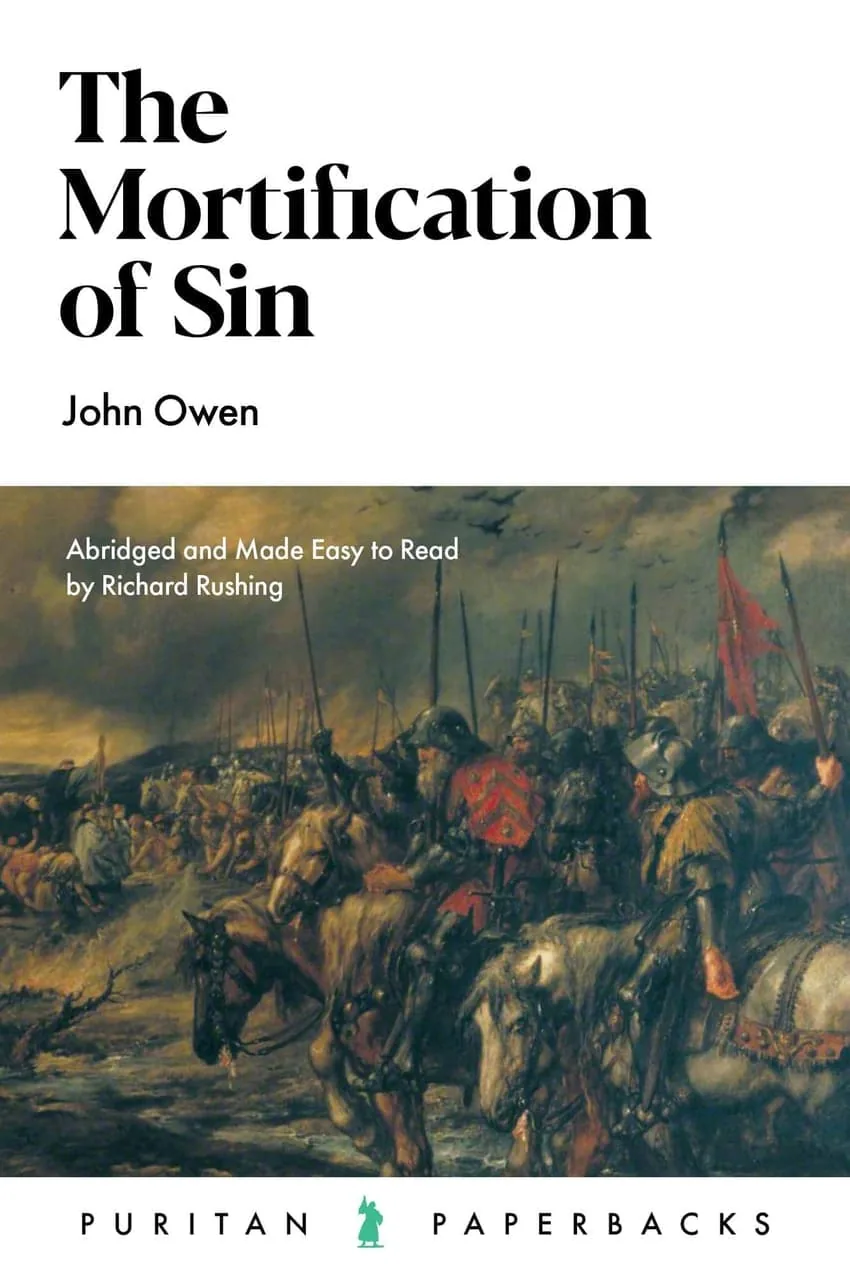
The Mortification of Sin
John Owen, Banner of Truth, 136 pages
The Banner of Truth Puritan Paperback is the edition most readers use: modernised spelling, lightly abridged, short chapters. The sentence is in chapter 2, near the start.

To read it free, the Christian Classics Ethereal Library carries the unabridged Goold text chapter by chapter, and Monergism hosts a modernised edition as a free PDF.
Frequently asked questions
Who said “be killing sin or it will be killing you”?
John Owen, the English Puritan theologian who lived from 1616 to 1683. He wrote it in his treatise Of the Mortification of Sin in Believers, first published in 1656.
Where does the quote come from?
Chapter 2 of Of the Mortification of Sin in Believers. In the standard collected edition it is on page 9 of volume 6 of The Works of John Owen, edited by William H. Goold and reprinted by the Banner of Truth Trust. Owen is arguing from Colossians 3:5 at that point, within a treatise built on Romans 8:13.
What did John Owen mean by it?
That a believer whose sins are already forgiven must still spend every day of life putting indwelling sin to death, because sin never stops working. Owen addresses it to Christians who are secure in Christ, not to the unconverted, and he insists the work is done by the Holy Spirit rather than by willpower.
Is “Be killing sin, or sin will be killing you” the exact wording?
No. Owen wrote “be killing sin or it will be killing you.” The version with “sin will be killing you” is extremely common but replaces Owen's pronoun. Adding a capital letter and a comma to make the clause a standalone sentence is fair, since in Owen it is the last of several imperatives in one long sentence.
Where can I read The Mortification of Sin for free?
The full text is public domain, since Owen died in 1683. The Christian Classics Ethereal Library carries the Goold text chapter by chapter, and Monergism hosts a modernised edition as a free PDF. Both are linked on this page.
What does mortification mean?
Mortification is the deliberate putting to death of sin that still remains in a Christian. It is the word the older English Bibles use to translate Paul in Romans 8:13 and Colossians 3:5. It does not mean humiliation or self-punishment, and it is not the same as sin being finally removed, which Owen says does not happen in this life.
Keep reading Owen
Browse every John Owen title on the site, or read more John Owen quotes. For the wider theme, see Puritan quotes on mortification of sin, indwelling sin, and sanctification. New to Owen? He is deliberately placed late in our guide to the best Puritan books for beginners, and how to read the Puritans explains why.